
In 1989 I went to Cairo for seven weeks to install and commission the electrical side of a new Planeta Super Variant P44: a 40-inch, six-color sheetfed offset press with a new Varicontrol color console. For the electrical portion, I was the only one. Where I was working, nobody else was needed.
The assignment was the whole nine yards—electrical installation, the console, commissioning, calibration, troubleshooting, cleanup, and making sure there were no loose ends left to chase me after I went home.
Twelve hours off
I was supposed to meet a driver from El Kayyashi, the Egyptian representatives in Cairo. The two brothers had confused a.m. and p.m. My arrival was therefore twelve hours off—or theirs was. I say theirs.
At the airport I was almost ambushed by local cab drivers, hotel owners, brothers and uncles of hotel owners, and everybody else with a solution to a problem I had not asked them to solve. Eventually I hailed a cab and was driven to somebody’s uncle’s hotel. I remember butter that smelled rancid. It was replaced. Perhaps it was Egyptian butter. Who knows?
The next morning I called the El Kayyashi brothers. They collected me, took me to their office, filled me in, and brought me to the customer.
They also relocated me, with profuse apologies, to the Old Shepheard Hotel. That was a considerable improvement. I had a suite with a separate living room and a view toward the Semiramis Hotel. The Nile was just around the corner, though the windows did not face it. Downstairs was the Asia House Indian restaurant, where I ate so regularly that breakfast, lunch, and dinner begin to blur together.
The plant
The customer was a government schoolbook printer. I no longer remember the plant’s name, and I will not invent one. It was farther inland, probably east of the Nile, in an old building with tall rooms and old staircases.
The pressroom was hot and humid. The paper was wavy and not of the quality a West German printer would have chosen for precision color work, but they made schoolbooks with it. Once the sheets were bound, the books became reasonably flat.
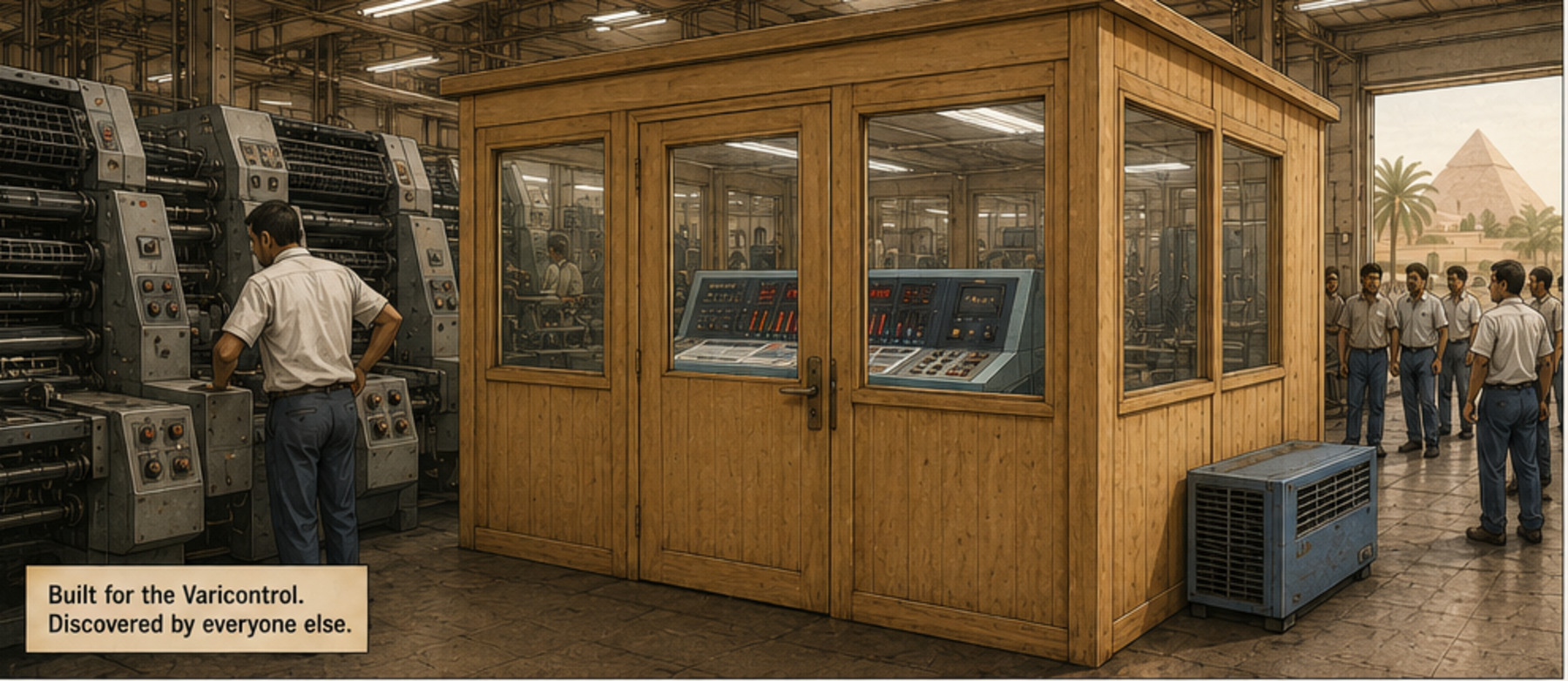
The new Varicontrol console was another matter. Its electronics could not be expected to live for long in that damp heat. There was no climate-controlled room for it. I told them they would have to build one.
Build a room
They started immediately, and their craftsmanship impressed me. The enclosure was approximately six by three meters. They used rough boards—wood only a little more refined than a raw tree trunk, nothing like the finished lumber in a German building-supply store. As far as I remember, they did not use plywood.
They built the walls, the double entrance doors, and even the window frames from scratch. They had sheets of glass, but no pre-hung windows. I do not remember hearing a circular saw. My recollection of knives and machetes may be exaggerated, but the room certainly did not arrive as a prefabricated kit.
A window air-conditioning unit went into the short wall, near the floor at about knee height and to the lower left when viewed from the double doors. A local electrician connected it—probably with a plug. When I left for the hotel, they were still working. When I returned the next morning, the room was finished and cold.
Everyone found it
They had discovered the air conditioning before the electronics arrived.
Ten or twelve people were crowded inside the little room because everywhere else was muggy, sticky, and unpleasant. In there, the air was dry and cold—perhaps even a little too cold. I greeted everybody and then had to gesture toward the same double doors through which they had entered.
I did not speak Arabic, and only a few people spoke English, but the meaning was clear. I needed to open the console and move around it. There was not enough room for everybody.
Engineers and supervisors visited occasionally, but they had their own air-conditioned offices. Not as cold as mine. For the duration of the commissioning, the coldest room in Egypt was effectively my workshop.
The ten-inch nail
The first job was to establish the power feed and verify the voltage before touching the main breaker. The plant supply was 380 volts, as it was called then. The console needed 220 volts, single phase, and I believe we used a transformer.
Once the incoming voltage was correct, I brought the console to life one stage at a time. Then I found the nail.
It was rusty, slightly bent, and about ten inches long. It was not driven into anything. It was lying across the contacts on the backplane behind the printed circuit boards. By luck, it had not bridged enough contacts to produce a short circuit.
It could not simply have fallen there. The console had arrived in a wooden crate, but its packaging had no use for a ten-inch rusty nail. I believed somebody had placed it deliberately, though I had no idea who or why. There was no point making a scene. A guilty person would not have volunteered, and the important fact was that no damage had been done.
If it had shorted the backplane and destroyed parts, I would have had to repair it. Depending on what was damaged and how quickly parts could reach Cairo, that might have turned seven weeks into a very long Egyptian vacation.
Commissioning the press
Commissioning was not a single dramatic event. It was days of calibration: zeroing the ink keys, matching the press potentiometers to the console feedback, setting the sweep motors and their potentiometers, and making the bar graphs agree with the actual opening across the ink fountain. The zero point was a small tapped voltage—something in the neighborhood of 0.5 to 0.8 volts, as I remember it.
The equipment was not old. It was brand new. In 1989 this was the current technology and the most modern Varicontrol console available. New did not mean self-adjusting. It still needed convincing before every display, motor, limit, and feedback circuit told the same story.
The mechanical press adjustments were handled by an experienced East German mechanic who was stationed in Cairo with his wife and two daughters. His name may have been Bernd, but I am not certain. He established pressures and solids, then the inking and dampening systems, and eventually a useful printed image. If an electrical function failed or required calibration, it came back to me.
One fault was familiar. The brush-shift motor mechanism would not leave minimum speed. The limit switch had been wired exactly as the factory schematic showed—and the schematic was wrong. Two wires had to be exchanged. The difficult part was not changing them; it was knowing that the official drawing was the fault.
I believe I was the first to identify that particular mistake. I reported it repeatedly, but bureaucracy moves slowly. On every customer machine I corrected the drawing itself, annotated the change, signed it, and dated it. The people responsible for the machine needed documentation showing what was actually there, not what an incorrect drawing claimed was there.
After roughly five weeks we had acceptable printing. The remaining two weeks were fine-tuning and troubleshooting: correcting and cleaning wiring, adjusting covers and cable troughs, and staying available for whatever appeared next.
Cairo after hours
The company assigned a worker and company car to drive me. I had priority getting to and from the plant because I told them I was not going to drive in Cairo. I had seen six cars occupy four marked lanes, most of them missing mirrors. Once we passed a woman who had been struck by a car. The moment disappeared behind us before I knew the outcome.
Mahmoud, one of the mechanics, became my practical go-to man. He was knowledgeable, genuinely nice, and more useful to me than the chief engineer who kept trying to flatter his way into a trip to Germany. I finally told the engineer to back off. There was little I could do for him, and butt-kissing was not going to change that.
Mahmoud took me downtown for masboot—dark, sweet coffee in very small cups—and my first shisha. While we sat outside, black soot began falling from the sky like heavy black snow. A nearby industrial plant was cleaning its smokestack by knocking the accumulated soot loose. Mahmoud told me to cover my coffee. Everybody else did the same. After a while it settled and life continued.
I visited the pyramids, but did not enter the Great Pyramid. The automotive bulbs at the entrance were powered by car batteries, and the batteries were discharged. There was no light. I did ride a camel. The handler waited until I was already on the animal before demanding one hundred dollars. I told him I was getting off and he would get nothing. We settled on five dollars, probably still too much, and all was hunky-dory.
Somewhere there was once a photograph of me on that camel in a bright purple shirt. I had bought two pairs of pants and two shirts in Cairo—purple and orange among the colors—with the East German family. Some photographs were later lost in a flood, and I do not know whether that one survived.
I was also led underground to a perfume dealer called the Green Crocodile. The selling method was persistent, bordering on coercive, but the perfume oils were worthwhile. I bought several, including some for my mother. Diluted with distilled water and alcohol, they could make a substantial quantity of perfume for comparatively little money.
There were two marriage proposals, or at least two events presented to me that way. The female boss at the printing company asked the chief engineer to translate a direct proposal. I declined politely, explaining that I was already married or committed. At a bar, a pretty young woman offered me food; an older man warned my American acquaintance Chuck that accepting it amounted to accepting a proposal. The food—flatbread, nuts, olives, perhaps falafel, something sweet and creamy—was delicious. The exact ingredients have not survived as well as the story.
Chuck and I met there regularly. After several meetings he told me he was with American intelligence and stationed at a nearby compound. He later bought my unusually thin, wedge-shaped metal laptop, which I shipped to him from Germany. I have never managed to identify its manufacturer.
I also joined the East German mechanic, his wife, and their daughters on a Nile cruise, possibly aboard a paddle steamer. I remember the atmosphere and smells more than any specific event. Whether El Kayyashi or an East German agency paid for it, I do not know. It was paid for, which was the useful part.
The christening
Toward the end of the assignment there was blood throughout Cairo. I saw an ox killed near the entrance to the El Kayyashi residence. At the printing plant, press personnel arrived with blood already collected in vessels and smeared it liberally over the new press’s cast-aluminum side covers.
I understood this as the christening of the press and, at the time, associated it with Ramadan. The calendar gives a more likely context: in 1989 Eid al-Adha fell in July, when animal sacrifice would explain the citywide scenes. I did not see the animal slaughtered at the plant, and I cannot say who performed a formal ritual, if anyone did.
What I did see was the press running with blood on its side covers. My understanding was that washing it off would have been sacrilegious, so it remained there to dry and come away on its own. In Cairo’s heat, it also smelled.
During the assignment, news reached the East German colleague of openings in the Iron Curtain through Hungary. I remember his relief, though not his exact words. He and his family remained in Cairo when I left; he was stationed there permanently, not on a short assignment.
Everything buttoned up
At the end of seven weeks, the press worked. The console worked. The drawings at the customer showed the corrected wiring. Covers and cable troughs were adjusted, the wiring was cleaned up, and nothing important remained unresolved.
I said goodbye, returned to the Old Shepheard, packed, and eventually went to the airport. I had met good people, particularly Mahmoud and the East German family, but leaving was never sad for me. Change is constant, and I like it. After seven weeks, I was ready for a different place.
The satisfaction was simpler than nostalgia. Everything had been buttoned up. I could sleep without wondering whether a loose end would follow me home.
What stayed behind was a six-color press producing schoolbooks, a corrected set of electrical drawings, and a handmade wooden room that had been built for a Varicontrol console and immediately discovered by everyone else.