
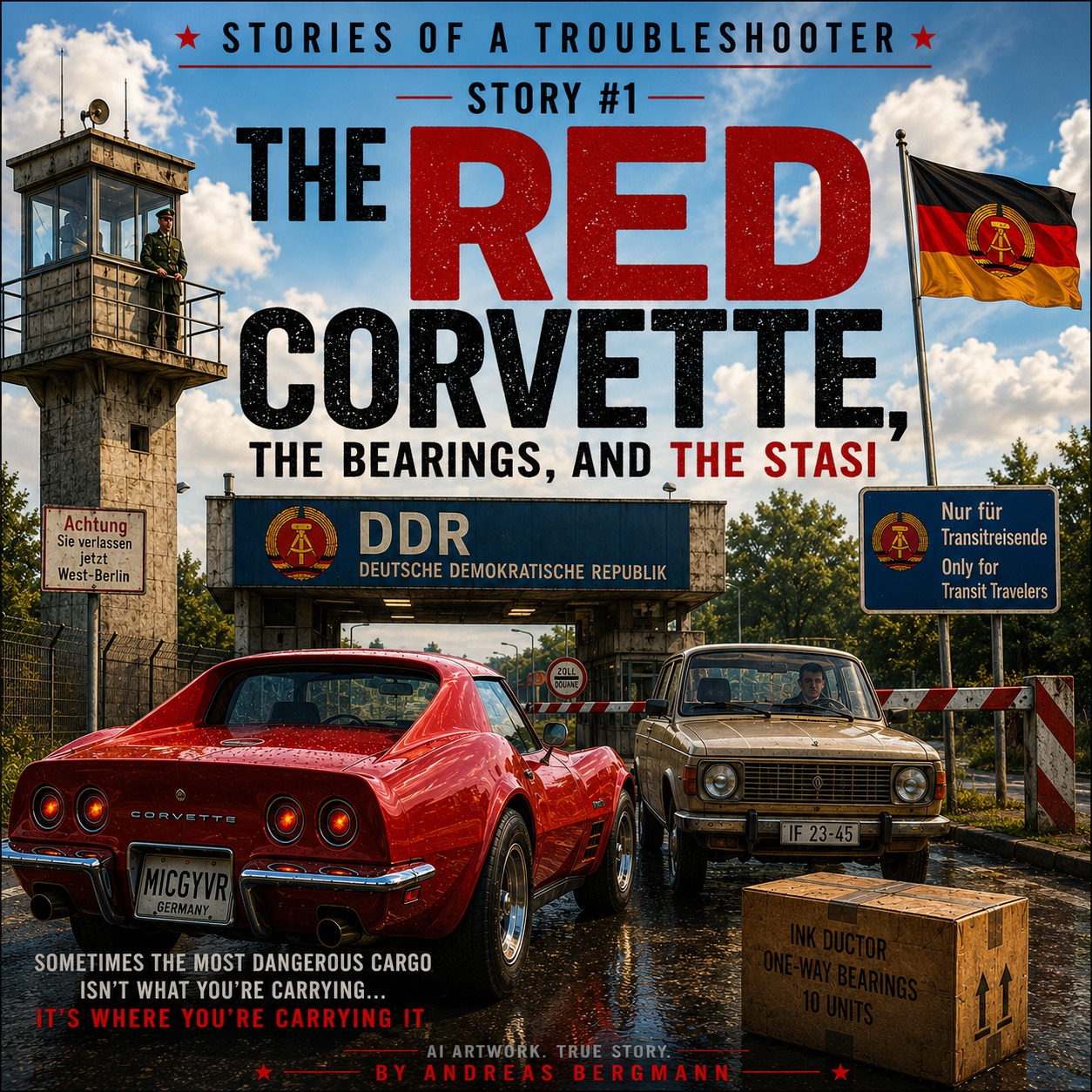
By the late 1980s, I was working for GRAPAMA in Hamburg. I had not planned on becoming a printing-press troubleshooter. The first time I touched a press, I was still at engineering school in Meldorf. My neighbor, Uwe Peterreit, asked me to look at a problem. I had never seen such a machine before.
The delivery looked like a Christmas tree: lights everywhere, relays clicking, 60-volt and 24-volt control circuits, and somewhere inside it all, diode N128 and relay K128. I found the fault. About six months later, I went to work for GRAPAMA.
The car
One day I saw it at Opel Dello on Nedderfeld in Hamburg: a red 1975 Corvette. The price was DM 30,000. The dealer had already dealt with the approvals and exemptions required for an American car whose lights, bumpers, and other details had not been designed for German regulations.
Thirty thousand marks. Legal. Ready to drive. I wanted it.
There was one minor problem. I did not have thirty thousand marks.
I mentioned the car to Fräulein Klau. She was not simply another coworker. She handled the bookkeeping and had substantial control over GRAPAMA’s finances. She knew the company’s numbers and had access to the financial information needed to decide whether the money could be advanced to me.
Klau approved or arranged the DM 30,000 and authorized it with her signature. I no longer know whether the money technically came from her personally or through the company, so I will not pretend that I do. What I remember clearly is that there was no interest and no rigid repayment schedule. I paid approximately DM 1,000 each month, and at the time of the East German trip I was still making those payments.
The assignment
Fräulein Rehling usually contacted me with assignments. She was GRAPAMA’s technical coordinator, a chain smoker with a raspy voice—nice, but rough around the edges. I was apparently one of her favorite troubleshooters.
GRAPAMA also had a man named Hannes Wendland who regularly drove between Hamburg and Dresden and carried things where they needed to go. My recollection is that Hannes was unavailable on this occasion. This trip was not routine for me. It was simply something different to do—and I had only one car: the red Corvette.
Rehling’s instruction sounded simple. Ten one-way bearings had to reach Planeta in Dresden, specifically the operation where printing units were assembled. They belonged in the ink-ductor mechanism: rotate one way, lock the other. Small, ordinary machine parts—but without them, ten printing units could not be completed.
The ink ductor meters ink into the press. Planeta used a flexible ink blade across the width of the unit. Small ink-zone motors acted through a knee-lever mechanism to flex that blade by a minute amount and regulate the ink gap. The exact movement is uncertain in my memory—perhaps around four-tenths of a millimeter—but the consequence was not uncertain. Production depended on those bearings.
As best I remember, Uwe Wilczek handed me the bearings. Rehling supplied the rendezvous:
I put the wrapped package behind the Corvette’s seats and headed east toward Berlin.
The handoff
I drove east from Hamburg toward the Zarrentin crossing. As the border approached, houses became fewer and the atmosphere changed. I passed first through the West German controls and then the East German controls. A red American Corvette among Trabants and Wartburgs naturally attracted attention, but I was not making a political statement. It was simply the car I owned.
I stopped at the first Intershop after the crossing. There was a delay. I no longer know whether the Wartburg was late or whether I simply failed to spot it at first.
Eventually I found the brown Wartburg Kombi. I took out the note, walked over, and visibly compared its number with the car’s license plate. It matched. I put the note back into my left rear jeans pocket.
I told the driver I had his bearings, walked back to the Corvette, and retrieved the package from behind the seats. The ten bearings were wrapped in oil paper and protective material. He opened the Wartburg’s rear hatch. I handed him the package. He put it inside.
No money. No password. No whispered conspiracy. The entire meeting lasted perhaps five minutes.
We said goodbye. I returned to the Corvette and continued toward Berlin.
I changed my mind
After finishing a GRAPAMA job, I sometimes made something of the trip—went somewhere, had a drink, saw something. But Berlin was still several hours away once you counted the drive, the return, and the border formalities. The assignment was already finished.
I simply did not feel like burning half a day for no reason.
So I found a way to turn the Corvette around and headed back toward Hamburg.
The border
When I reached the East German checkpoint again, I was pulled out of the normal traffic flow and directed through a gate into a controlled area. The Corvette went onto an elevated vehicle-inspection ramp or booth.
I was told to lock the car. I questioned the logic: why lock it if they intended to inspect it? I may have handed over the keys because I did not want anyone damaging the Corvette to gain entry. I may have kept them. That detail is no longer reliable enough to state as fact.
Before I was taken away from the car, an official gave an instruction that stripped away any doubt about what had happened.
That was exactly where I had put the Wartburg’s license-plate number. I had not told him. He knew.
The most plausible explanation is that somebody at the Intershop had watched me compare the plate and return the note to that pocket. With the Corvette attracting attention from all directions, I cannot say who observed me. The fact is only that the border officials knew exactly where the note was.
Two armed guards stayed with me. They did not point their weapons at me. They simply spoke very little. I was taken into a nearby building and told to sit on one of the folding metal chairs in a foyer or waiting area. At one point I said something like, “You guys don’t talk much, do you?” They did not answer. I may have waited there for about an hour, although time was difficult to judge.
Eventually an older, higher-ranking officer questioned me. He could have been old enough to be my father, but there was nothing paternal in his manner. My memory of him is intensely negative. I felt that he regarded me as an enemy, and before long I regarded him the same way.
QuestionWhat did you deliver?
AnswerBearings.
QuestionWhat kind?
AnswerOne-way bearings.
QuestionFor whom?
AnswerPlaneta. For printing presses.
From my side, there was no secret to protect. I was an engineer delivering spare parts to a customer. From their side, a West German in a conspicuous American sports car had crossed the border, met a stranger at a prearranged location, identified him by license plate, handed over a wrapped package, driven toward Berlin, turned around unexpectedly, and returned.
I could see how it looked. That did not make their version true.
The officer said they did not know what I had done while I was in East Germany. That irritated me because the available time made the suspicion seem ridiculous. I had crossed the border, stopped at the first Intershop, made the delivery, driven for a while, turned around, and returned. My unexplained window was perhaps one or two hours. What was I supposed to have done—stolen some chickens? That is how I joke about it now, not something I remember saying then.
At one point the officer said, “Wir brauchen Leute wie Sie nicht.” We do not need people like you.
I disagreed. Their printing presses were waiting for ten bearings they apparently could not get easily themselves. As far as I was concerned, they very much needed people like me.
They did not appreciate the observation.
I do not remember being formally accused of espionage, smuggling, violating a named law, or committing any specific crime. The questioning was serious and hostile, but that distinction matters: no formal criminal accusation was stated to me.
The statement
Eventually the officer produced a written statement for me to sign. Most of it, as far as I remember, contained ordinary factual information about the delivery. One part was wrong.
Earlier he had asked whether I thought other companies did the same thing. I had answered that I did not know. I had no way of knowing what other companies did. The written statement instead said, in substance, that I had stated other companies used the same practices.
Those are not the same words. They are not the same fact.
I said, in substance, “No, I don’t. Watch me. I’m not signing it.” The two lower-ranking guards appeared surprised. That is my interpretation of their reaction, not something they said. I do not remember a threat or a physical confrontation. The officer eventually left.
I waited again with the armed guards. They continued to stand there and barely spoke, as though I were an extremely dangerous man. The entire detention may have lasted approximately four hours, although that remains an estimate.
Released
Eventually someone simply told me, “You can go.” There was no further interrogation. No jail. No charge. I was not required to sign the disputed statement. I returned to the Corvette, drove it out through the gate, and headed toward the West German border.
During the confrontation I had behaved defiantly. Part of my attitude was: I am a West German; you cannot touch me. Whether that belief was justified is another question. The genuine relief came only when I crossed back into West Germany and knew I was safely on my own side.
I returned to GRAPAMA later that day, probably in the late afternoon. People knew something had happened because I was late. Uwe Peterreit told me I had been very lucky not to end up in jail. Wolfgang Kunigh, a mechanic with whom I later had many other adventures, made jokes about it. Then life moved on.
I already knew Mrs. Neblung of Polygraph. Afterward, I was told that Polygraph had intervened and that its influence may have helped secure my release or prevent a longer detention. I never discussed it with Mrs. Neblung, and she never told me what she had done. It therefore remains something I was told later—not something I witnessed.
Nobody at GRAPAMA made a ceremony of the incident. The job had been completed. Planeta had the bearings, and the ten printing units could be completed. I had returned with myself and the Corvette intact.
That was apparently enough.
What stays with me is how ordinary the beginning was. Planeta needed ten bearings. GRAPAMA had ten bearings. I had a car. So I delivered them.
The East German security apparatus saw something suspicious. I saw an ordinary company errand that had gone sideways.
And that may be the best summary of troubleshooting I know: sometimes you think you are delivering ten bearings. Someone else thinks you are conducting espionage. Either way, when I left, Planeta had its parts and the units could be completed.
And I was still driving the red Corvette.